SO i though it might be interesting to breakdown the different constituents of commonly sold fish food (be it frozen, flake, liquid etc - they all fit in somehow).... you know at the back of the container/packet it usually breaks down the elements; ever wondered their importance?
Protein
They are very important elements which are the building blocks of life and perform a huge number of biological functions. They are made up of many different amino acids in different combinations to create different proteins. Most fish food contains types of fish or meat in crude form to provide the proteins to your fishes diet i.e. beef heart etc. When using frozen food it is important to consider that the actual freezing process causes the internal cell walls of the frozen product (i.e. brine shrimp, plankton or blood worms) to break releasing all the good nutrients; this a good reason to not feed your fish a frozen food only diet.
Feeding your fish only frozen foods (such as blood worms etc) can lead to your fish to developing deficiencies.
Vitamins
Vitamins are organic compounds essential to animals in small quantities for growth and healthy living. These essential nutrients are also often lost from fish food due to the process of sterilisation, freeze drying or freezing. Some vitamins are able to be synthesized by the animal itself where as others need to be provided as part of the diet. Vitamins can be both water and fat soluble therefore, it is important to feed your fish good quality food to ensure it is formulated well and, contains these essential vitamins which they need to get via their diet. It doesn't hurt to feed your fish a variety of foods just to make sure you cover all their essential dietary requirements.
Fats/Lipids
Lipids provide many very important biological functions in animals including fish. They are used as structural components of animal cell membranes, they provide fuel for internal processes, and of course insulation. Many fish foods contain amounts of fat or lipids as they are essential nutrients to fish however, can also do harm if fish are fed this particular element in abundance. There are both saturated and unsaturated types of fats and foods such as beef heart contain high amounts of saturated fats. In most instances the quality flake/pellet food available at your local fish store will contain the right amounts of saturated and unsaturated fats. These foods also contain types of preservatives to stop the food from going off and things such as fats from breaking down. Probably best to use a spoon instead of your fingers to feed your fish because, the water in your aquarium (and even you tap) contains many different types of bacteria and fungi which start the process of spoiling your fish food....
So to sum up best to feed your fish a varied diet frozen, freeze dried and pellet/flake food. Where possible do not overfeed them with frozen or live foods as its not healthy for them and, try and keep the food container free of wet fingers :)
Tuesday, June 22, 2010

Monday, June 14, 2010
Carbonate hardness/pH.... what is it?
The carbonic acid-bicarbonate (ion) buffer system
pH and carbonate hardness in aquariums - and in general when it comes to water chemistry - can be seen as linked due to their overlapping relationship. Often when reading blogs, books, magazines, or talking to other hobbyists, people interchange terms like carbonate hardness and pH. The relationship is not that simple especially if chemistry isn't your favourite subjects (like most of us) but, I will have a go at explaining anyway.
What is pH ? It is the concentration of Hydrogen (H+) ions in a solution. The scale is logarithmic ( i.e. when you get a pH reading of 8 or 10 - you actually have a much lower concentration of free H+ ions then if you have a pH of 3.... sounds backwards.... that's science). The pH of tap water is around 7 which is considered neutral.
What is a Buffer ? In aquariums and other solutions they are substances which act as regulators for H+ ions i.e. they accept them or release them depending on their availability in the solution and also the concentration of the buffer. This causes them to buffer the pH at a certain value hence the name.
What are acids? they are substances which release hydrogen (H+) ions
What are Bases? they are substances which take up hydrogen (H+) ions
So how are they all linked? Consider a saltwater aquarium with a pH of 8.3 (High pH = basic). Carbonic acid is formed in a reversible reactions via the following reaction:
CO2 + H2O <--> H2CO3 (carbonic acid) <--> H + HCO3 (hydrogen and bicarbonate ions)
When the aquarium experiences an increase in hydrogen atoms (H+) the bicarbonate (or base) combines with the H+ to form carbonic acid H2CO3 (acid). The carbonic acid is relatively unstable and eventually turns into H2O and CO2. If there is a increase in hydroxide (-OH) ions in the aquarium the carbonic acid actually releases bicarbonate and water e.g.
OH (Hydroxide) + H2CO3 (carbonic acid) <--> H2O (water) + HCO3 (bicarbonate ion)
So basically these two reactions keeps your pH stable.
So your aquarium - hopefully a buffered one - maintains a stable pH by using buffers which release or take up hydrogen (H+) and hydroxide (-OH) ions via carbonic acid or bicarbonate. When you measure the kH with your aquarium test kit your a detecting the available bicarbonate molecules. From my experience kH tends to be more important in saltwater aquariums because, the animals which live in these ecosystems require a higher pH and are very sensitive to changes in pH. Many of the commonly available freshwater species (from fish stores) can survive in water from the tap providing it has be been de-chlorinated i.e. they are happy with the neutral pH.
In the aquarium hobby it is quite common for people to add tap water directly into their freshwater or saltwater aquariums. This tap water contains a neutral pH with very little buffering capacity i.e. one of the reasons why it is dangerous to add it to saltwater aquariums.
Hope this info was helpful and not too confusing.....
pH and carbonate hardness in aquariums - and in general when it comes to water chemistry - can be seen as linked due to their overlapping relationship. Often when reading blogs, books, magazines, or talking to other hobbyists, people interchange terms like carbonate hardness and pH. The relationship is not that simple especially if chemistry isn't your favourite subjects (like most of us) but, I will have a go at explaining anyway.
What is pH ? It is the concentration of Hydrogen (H+) ions in a solution. The scale is logarithmic ( i.e. when you get a pH reading of 8 or 10 - you actually have a much lower concentration of free H+ ions then if you have a pH of 3.... sounds backwards.... that's science). The pH of tap water is around 7 which is considered neutral.
What is a Buffer ? In aquariums and other solutions they are substances which act as regulators for H+ ions i.e. they accept them or release them depending on their availability in the solution and also the concentration of the buffer. This causes them to buffer the pH at a certain value hence the name.
What are acids? they are substances which release hydrogen (H+) ions
What are Bases? they are substances which take up hydrogen (H+) ions
So how are they all linked? Consider a saltwater aquarium with a pH of 8.3 (High pH = basic). Carbonic acid is formed in a reversible reactions via the following reaction:
CO2 + H2O <--> H2CO3 (carbonic acid) <--> H + HCO3 (hydrogen and bicarbonate ions)
When the aquarium experiences an increase in hydrogen atoms (H+) the bicarbonate (or base) combines with the H+ to form carbonic acid H2CO3 (acid). The carbonic acid is relatively unstable and eventually turns into H2O and CO2. If there is a increase in hydroxide (-OH) ions in the aquarium the carbonic acid actually releases bicarbonate and water e.g.
OH (Hydroxide) + H2CO3 (carbonic acid) <--> H2O (water) + HCO3 (bicarbonate ion)
So basically these two reactions keeps your pH stable.
So your aquarium - hopefully a buffered one - maintains a stable pH by using buffers which release or take up hydrogen (H+) and hydroxide (-OH) ions via carbonic acid or bicarbonate. When you measure the kH with your aquarium test kit your a detecting the available bicarbonate molecules. From my experience kH tends to be more important in saltwater aquariums because, the animals which live in these ecosystems require a higher pH and are very sensitive to changes in pH. Many of the commonly available freshwater species (from fish stores) can survive in water from the tap providing it has be been de-chlorinated i.e. they are happy with the neutral pH.
In the aquarium hobby it is quite common for people to add tap water directly into their freshwater or saltwater aquariums. This tap water contains a neutral pH with very little buffering capacity i.e. one of the reasons why it is dangerous to add it to saltwater aquariums.
Hope this info was helpful and not too confusing.....
Sunday, June 6, 2010
Algae - A Problem Solver Guide (Julian Sprung)
Search Amazon.com for algae a problem solver guide Algae - A Problem Solver Guide (Julian Sprung)
What can i say but, what a great book.
So many people are discouraged by the nuisance algae which grows in aquariums and, often the most frustrating thing about algae is how to control it. Often when starting in the aquarium hobby the easiest thing to do to control algae is perform periodic cleaning of aquarium glass. Why would you want to spend all that money on a new aquarium only to have to devote your time every few days (sometimes more) cleaning algae of the aquarium glass/plants/ rocks etc etc. Well the great thing about this book is that Julian explains in great detail the biology of algae, their food sources (primary carbon sources) and, ways to control them. On top of the biology, food and control of algae this book also devotes a whole chapter to pictures and descriptions of commonly encountered algae. Now this book can be used for beginners but, if your a experienced aquarist and, want a detailed read to sink your teeth into then this is for you. Please note most of discussion on algae seems to be focused on algae which is encountered in saltwater aquariums. However, i do believe this logic can be applied to freshwater aquariums and, help you succeed in controlling problem algae in any type of aquarium.
The book starts off by explaining the biology of algae i.e. what are they, reproduction, structure, phenotypic appearance and then he goes into a detailed description about all the different elements and water chemistry which commonly act as algal food sources, how these elements effect algae and, may even stop them. Followed by the commonly assumed causes of algal growth i.e. lighting, over feeding , filtration etc etc.
Chapter two delves into ways to control algae starting from the biological i.e. snails, invertebrates, macro algae, fish, to biological filtration (corals, plants etc) to commonly available over the counter methods. Really has a tremendous amount of information to go on if your keen to get algae under control.
Chapter three goes into detail about the different types of algae, how to identify them (description and, pictures) and ways to control them.
And, finally there is a glossary and an index.
I would give this book a overall rating of 8/10 - it would be a ten but, being a aquarium fanatic it just left me wanting more information - but, i guess half the fun with this hobby is finding these things out for yourself.
If your keen on learning more about your aquarium and, how to control nuisance algae definitely buy this book.
Features (as described on the back of the front cover):
- Identifies algae that become "problematic" in aquariums
- Explains the physical, chemical and biological requirements of algae
- Over 180 photographs taken including under the microscope to show important identifying features
- Extensive recommendations for ways to control algae growth
- How to eliminate red slime algae once and for all
- How to stop green hair algae from ruining your aquarium
- How to stop a dinoflagellate bloom
- How to control diatoms
- New herbivores for controlling Bryopsis and other hair algae
- New herbivores that eat Valonia
ENJOY
Algae - A Problem Solver Guide (Julian Sprung)What can i say but, what a great book.
So many people are discouraged by the nuisance algae which grows in aquariums and, often the most frustrating thing about algae is how to control it. Often when starting in the aquarium hobby the easiest thing to do to control algae is perform periodic cleaning of aquarium glass. Why would you want to spend all that money on a new aquarium only to have to devote your time every few days (sometimes more) cleaning algae of the aquarium glass/plants/ rocks etc etc. Well the great thing about this book is that Julian explains in great detail the biology of algae, their food sources (primary carbon sources) and, ways to control them. On top of the biology, food and control of algae this book also devotes a whole chapter to pictures and descriptions of commonly encountered algae. Now this book can be used for beginners but, if your a experienced aquarist and, want a detailed read to sink your teeth into then this is for you. Please note most of discussion on algae seems to be focused on algae which is encountered in saltwater aquariums. However, i do believe this logic can be applied to freshwater aquariums and, help you succeed in controlling problem algae in any type of aquarium.
The book starts off by explaining the biology of algae i.e. what are they, reproduction, structure, phenotypic appearance and then he goes into a detailed description about all the different elements and water chemistry which commonly act as algal food sources, how these elements effect algae and, may even stop them. Followed by the commonly assumed causes of algal growth i.e. lighting, over feeding , filtration etc etc.
Chapter two delves into ways to control algae starting from the biological i.e. snails, invertebrates, macro algae, fish, to biological filtration (corals, plants etc) to commonly available over the counter methods. Really has a tremendous amount of information to go on if your keen to get algae under control.
Chapter three goes into detail about the different types of algae, how to identify them (description and, pictures) and ways to control them.
And, finally there is a glossary and an index.
I would give this book a overall rating of 8/10 - it would be a ten but, being a aquarium fanatic it just left me wanting more information - but, i guess half the fun with this hobby is finding these things out for yourself.
If your keen on learning more about your aquarium and, how to control nuisance algae definitely buy this book.
Features (as described on the back of the front cover):
- Identifies algae that become "problematic" in aquariums
- Explains the physical, chemical and biological requirements of algae
- Over 180 photographs taken including under the microscope to show important identifying features
- Extensive recommendations for ways to control algae growth
- How to eliminate red slime algae once and for all
- How to stop green hair algae from ruining your aquarium
- How to stop a dinoflagellate bloom
- How to control diatoms
- New herbivores for controlling Bryopsis and other hair algae
- New herbivores that eat Valonia
ENJOY
Sunday, May 30, 2010
Cloudy white water - bacterial bloom explained
A common situation that my customers face with new aquariums (and, of course in established aquariums) is bacterial blooms - the cause of cloudy white water in an aquarium.
In new and established aquariums this is the result of waste products being broken down by bacteria and, a spike in ammonium following.
There can be many causes for this.... in a new aquarium it can be a result of excess nutrients in the water. This results in certain types bacteria multiplying in huge numbers to breakdown the waste causing a milky white effect in the water. The bacteria will eventually die off as a result of starvation when their nutrients in the water decrease i.e. there is less food for them to eat. An ammonium spike usually follows the appearance of this cloudy white water followed by the next group of bacteria that grow and breakdown the ammonium. Once the full cycle is complete i.e. ammonium --> nitrite --> nitrate you will notice that on your water test kit no longer registers ammonium or nitrite and, but registers nitrate in your water.
In cycled aquariums bacteria blooms can be caused by overfeeding or washing the aquarium filter with fresh tap water which contains chlorine - killing the colonies of established bacteria in your filter resulting in a reset of the bacterial cycle therefore, a bacterial bloom.
If this were to happen the best thing to do is to make sure your air stone is on full ball and your water surface agitation is at its maximum. Fish will usually survive this event in a freshwater tank.... but, probably not a saltwater tank. Its best to try to avoid resetting your aquarium cycle as this causes stress to your fish and often results in diseases such as white spot.
When first starting in the aquarium hobby (about 10 years ago) I went through the stress of bacterial blooms and associated ammonia spikes a number of times. At one stage I owned a 3 foot saltwater tank with a canister filter and about 10 kg's of live rock, a pyjama cod and a lion fish (although i had no idea about their ferocious eating habits - which I was unequipped for). As many new marine hobbyists do I fed them way too much and, as a result caused a bacterial bloom and a huge ammonium spike! Needless to say this killed both my fish ... due to my impatience..... the tank was only 1 month old and deciding to add these two hungry beasts into my aquarium was not a wise choice. The bacterial colonies in the tank and filter were not established yet.... well not enough to handle the these fish and their waste.
As if this experience wasn't enough I tried again i.e. got rid of these dead fish let the tank cycle again and, then added a few corals (not such a bad idea). However, I made the unwise choice of adding liquid coral food and more than likely overdosed the system. Next morning I woke to find that the aquarium had turned cloudy white again! and, that all the live rock had died off.... the tank had a putrid smell. Besides overfeeding.... in hindsight the canister filter probably wasn't the best choice for this aquarium.
When first starting in the hobby most people do not realise how much work is involved with setting up an freshwater or saltwater aquarium.
So more often than not bacterial blooms will resolve themselves however, 25% water changes don't hurt and, holding off of feeding your fish is probably a good idea also.
Dan
In new and established aquariums this is the result of waste products being broken down by bacteria and, a spike in ammonium following.
There can be many causes for this.... in a new aquarium it can be a result of excess nutrients in the water. This results in certain types bacteria multiplying in huge numbers to breakdown the waste causing a milky white effect in the water. The bacteria will eventually die off as a result of starvation when their nutrients in the water decrease i.e. there is less food for them to eat. An ammonium spike usually follows the appearance of this cloudy white water followed by the next group of bacteria that grow and breakdown the ammonium. Once the full cycle is complete i.e. ammonium --> nitrite --> nitrate you will notice that on your water test kit no longer registers ammonium or nitrite and, but registers nitrate in your water.
In cycled aquariums bacteria blooms can be caused by overfeeding or washing the aquarium filter with fresh tap water which contains chlorine - killing the colonies of established bacteria in your filter resulting in a reset of the bacterial cycle therefore, a bacterial bloom.
If this were to happen the best thing to do is to make sure your air stone is on full ball and your water surface agitation is at its maximum. Fish will usually survive this event in a freshwater tank.... but, probably not a saltwater tank. Its best to try to avoid resetting your aquarium cycle as this causes stress to your fish and often results in diseases such as white spot.
When first starting in the aquarium hobby (about 10 years ago) I went through the stress of bacterial blooms and associated ammonia spikes a number of times. At one stage I owned a 3 foot saltwater tank with a canister filter and about 10 kg's of live rock, a pyjama cod and a lion fish (although i had no idea about their ferocious eating habits - which I was unequipped for). As many new marine hobbyists do I fed them way too much and, as a result caused a bacterial bloom and a huge ammonium spike! Needless to say this killed both my fish ... due to my impatience..... the tank was only 1 month old and deciding to add these two hungry beasts into my aquarium was not a wise choice. The bacterial colonies in the tank and filter were not established yet.... well not enough to handle the these fish and their waste.
As if this experience wasn't enough I tried again i.e. got rid of these dead fish let the tank cycle again and, then added a few corals (not such a bad idea). However, I made the unwise choice of adding liquid coral food and more than likely overdosed the system. Next morning I woke to find that the aquarium had turned cloudy white again! and, that all the live rock had died off.... the tank had a putrid smell. Besides overfeeding.... in hindsight the canister filter probably wasn't the best choice for this aquarium.
When first starting in the hobby most people do not realise how much work is involved with setting up an freshwater or saltwater aquarium.
So more often than not bacterial blooms will resolve themselves however, 25% water changes don't hurt and, holding off of feeding your fish is probably a good idea also.
Dan
Saturday, May 22, 2010
Nitrogen cycle explained

Nitrogen Cycle
The nitrogen cycle is a term used to explain the cycle that breaks down fish waste and other
types of waste into Nitrate, a process which occurs in your aquarium (fresh or saltwater).
When fish waste enters into the aquarium (i.e. Nitrogenous waste) it is quickly converted into
ammonium, a very toxic substance for fish. Bacteria which live in an aquarium have the job of
breaking this ammonium down into nitrite; another substance toxic to fish. The breakdown of
ammonium to nitrite requires oxygen and, the presence of Aerobic bacteria (i.e. bacteria which
require oxygen to survive). The final step in the cycle also requires oxygen and aerobic bacteria
to breakdown nitrite into nitrate, which is the least toxic of the substances in the cycle; this is a
substance which typically builds up in an aquarium which requires a water change to remove.
Fish can tolerate higher levels of nitrate however; this can also get too concentrated in an
aquarium and also cause fish to stress. High nitrate levels can compromise the immune/defence
systems of fish, and cause problems like white spot.
Usually ammonium or nitrite is present in an aquarium when it is first set up. Reason being, that
each step in the process requires different types of bacteria however, it takes a while for these
bacteria to colonize and grow in your filter and aquarium gravel/decor etc. Once these bacteria
have colonized the aquarium they will breakdown the ammonium and nitrite to nitrate very
efficiently so long as the fish are not overfed or overpopulated in the aquarium. It normally takes
about 2 -3 weeks for the cycle to establish in a freshwater aquarium (longer in a saltwater
aquarium). If ammonium or nitrite is detected in an aquarium after it has been established, it can
mean that the fish are being overfed, which in turn is causing the fish to create more waste than
the aquarium can handle. The following levels would be considered toxic to fish and other
animals in an aquarium:
Nitrogenous Compounds Concentration limit for an aquarium:
Ammonium 0.4 ppm
Nitrite 0.1 ppm
Nitrate 100 ppm
ppm = (parts per million)
*** When the concentration of nitrate reaches 50 ppm it is best to perform a 25% water change.
So what happens with the Nitrate?
Well, nitrate is actually broken down by anaerobic bacteria (bacteria which survive in an
environment containing NO oxygen). Due to the fact that most aquariums do not contain many
areas for the anaerobic bacteria to live, nitrate isn’t actually broken down very fast and tends to
build up in an aquarium, so water change is a must. Filters, when working correctly are quite
saturated with oxygen from the aquarium water therefore; do not typically contain these bacteria
either. In the wild, it’s a different story – there are many places for these types of bacteria to live
therefore the water quality will always be much better than what most aquarists can simulate in
an aquarium.
Filter
This is where the breakdown of the majority of waste happens. The explanation above details the
process that actually takes place inside the filter and, to a lesser extent in the actual aquarium, on
rocks, in gravel and on decor or plants. For this reason it is vital to never wash filter media with
tap water which contains chlorine, this will kill the bacteria in the filter. It is always best to wash
filter media with aquarium water, or only change the filter wool and leave the rest of the filter
Monday, May 3, 2010
Here fishy fishy
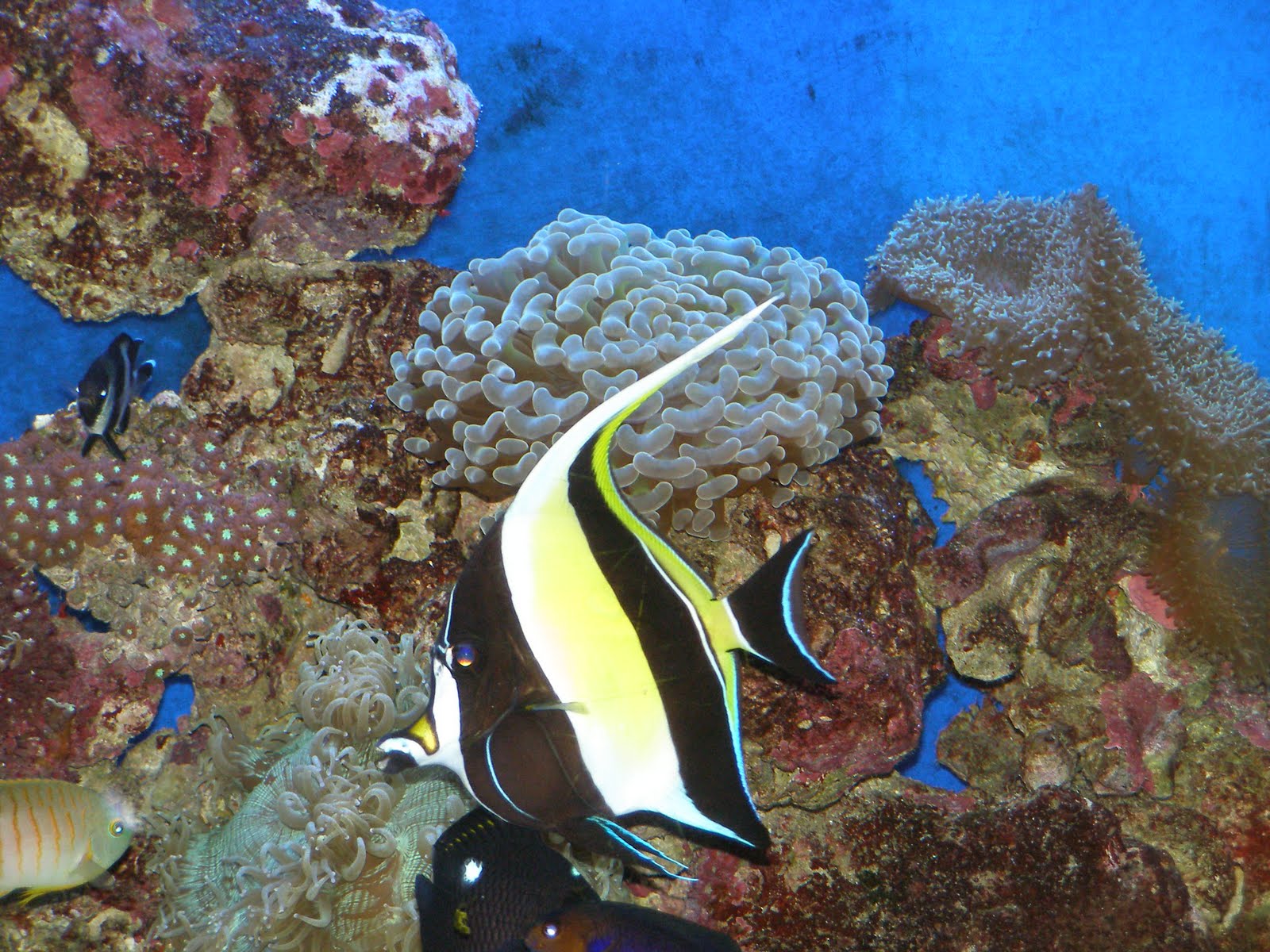
Just a couple of pictures of the 4X2X2 salt-water fish tank. The coralline algae are starting to grow all over the rocks and, even though the tank is bare in terms of corals I think this tank looks awesome.
So basically all water changes are done using pre-bought ocean water which has a constant salinity of 1.022/1.023. Interestingly enough water is only changed once a month however, this tank has been going for about 2/3 years so it has established quite a good bacterial colony in the filter media.
Mod's done to the filter include - removal of all plastic bio-balls (waste collectors and nitrate factories...in my opinion). Addition of matrix filtration - repaired protein skimmer which works a charm. The filter itself has quite a deep layer of course coral sand - probably a good nitrate reductor.
Tropic Marin trace elements added once weekly and fish fed 3-4 times week with spectrum, brine shrimp and algae wafers.
Here is some pictures:


So basically all water changes are done using pre-bought ocean water which has a constant salinity of 1.022/1.023. Interestingly enough water is only changed once a month however, this tank has been going for about 2/3 years so it has established quite a good bacterial colony in the filter media.
Mod's done to the filter include - removal of all plastic bio-balls (waste collectors and nitrate factories...in my opinion). Addition of matrix filtration - repaired protein skimmer which works a charm. The filter itself has quite a deep layer of course coral sand - probably a good nitrate reductor.
Tropic Marin trace elements added once weekly and fish fed 3-4 times week with spectrum, brine shrimp and algae wafers.
Here is some pictures:

Monday, April 26, 2010
Julian Sprungs - Invertebrates reference guide
This was the first marine reference guide I purchased and, contains some very interesting reading material. When you first start dabbling in reef tanks you have all sorts of questions like what’s that mushroom looking thing or what’s that snail creature?
The great thing about this book is it helps you understand those weird and wonderful things we all discover in our marine aquariums like Foraminiferans (Forams) which often come attached to live rock or the sponges that many people tend to not to notice but, form a part of any reef ecosystem. The book also covers things like corallimorphs, clams, anemones, starfish, zooanthids, nudibranchs, different types of snails and obvious things like crabs plus, many of those interesting creatures you discover at night.
As you know this book was written from a US perspective but, does a great job at covering a broad spectrum of invertebrates which you would find (i am assuming) all over the world including the land down-under.
Now this book isn't going to give you all the information you need to know about how to maintain this wonderful inverts. However, it will give you the important tid bits that will help you along the way. For instance Julian indicates the following for all the inverts:
- “Scientific name
- Common name
- Hardiness in captivity
- Regions (where it is found in the wild)
- Desirable/undesirable features
- Similar organisms
- Feeding requirements
- Special considerations”
And, of course loads of great pictures.
The book contents/index goes as follows (a few sections have been omitted):
“Chapter One – Foraminiferans”
“Chapter Two – Sponges”
“Chapter Three – Cnidaria”
“Chapter Four – Flatworms”
“Chapter Five – Mollusks”
“Chapter Six – Worms”
“Chapter Seven – Arthropods”
“Chapter Eight – Echinoderms”
“Chapter Nine – Tunicates”
I would recommend purchasing this book and, the other Julian Sprung book “Corals - a quick reference guide” if you’re serious on going on the reef aquarium journey.
Reference: Oceanographic Series – Invertebrates: A Quick Reference Guide
Copyright 2001 Reference Guide
First Printed June 2001
Published by Ricordea Publishing, Miami, Florida, USA\
Author: Julian Sprung
Book Design by Daniel N. Ramirez
The great thing about this book is it helps you understand those weird and wonderful things we all discover in our marine aquariums like Foraminiferans (Forams) which often come attached to live rock or the sponges that many people tend to not to notice but, form a part of any reef ecosystem. The book also covers things like corallimorphs, clams, anemones, starfish, zooanthids, nudibranchs, different types of snails and obvious things like crabs plus, many of those interesting creatures you discover at night.
As you know this book was written from a US perspective but, does a great job at covering a broad spectrum of invertebrates which you would find (i am assuming) all over the world including the land down-under.
Now this book isn't going to give you all the information you need to know about how to maintain this wonderful inverts. However, it will give you the important tid bits that will help you along the way. For instance Julian indicates the following for all the inverts:
- “Scientific name
- Common name
- Hardiness in captivity
- Regions (where it is found in the wild)
- Desirable/undesirable features
- Similar organisms
- Feeding requirements
- Special considerations”
And, of course loads of great pictures.
The book contents/index goes as follows (a few sections have been omitted):
“Chapter One – Foraminiferans”
“Chapter Two – Sponges”
“Chapter Three – Cnidaria”
“Chapter Four – Flatworms”
“Chapter Five – Mollusks”
“Chapter Six – Worms”
“Chapter Seven – Arthropods”
“Chapter Eight – Echinoderms”
“Chapter Nine – Tunicates”
I would recommend purchasing this book and, the other Julian Sprung book “Corals - a quick reference guide” if you’re serious on going on the reef aquarium journey.
Reference: Oceanographic Series – Invertebrates: A Quick Reference Guide
Copyright 2001 Reference Guide
First Printed June 2001
Published by Ricordea Publishing, Miami, Florida, USA\
Author: Julian Sprung
Book Design by Daniel N. Ramirez
Thursday, April 22, 2010
Aquarium Worksheet - Parameters instructions etc.....
If your looking for help on how to get your aquarium up and running be that a saltwater fish only tank, reef tank or freshwater tank I have developed a worksheet which you can use to guide you throught the process. Basically it will cover all water parameters and calculations you need - outline below:
Example:
Reef Tank
Water parameters
Lighting
Feeding requirements
Measuring and maintaining trace elements and other water chemistry
When to do water changes
*** Aquariums look beautiful when you can.... to the best of your ability and funding ......replicate the lifestyle that suits your particular fish you wish to purchase. Many people go out an buy an aquarium and, have no idea of the set-up and maintenance requirements that these aquariums require. What I would like to offer (IN THE NEAR FUTURE) is a worksheet which you can use to keep your aquarium looking pristine. Soon from my fishebiz.com.au website you will be able to download a pdf. document (for a small fee) which will give you all the information you need to maintain your aquarium.
Why would you bother?
Well you might spend countless hours visiting aquarium stores having no real idea what your after - I have done that - by no idea I mean you may not have had the knowledge of what requirements your fish need.
You might get loads of free advice which often doesn't give you the whole picture.
More often than not the best solution for most problems encountered in an aquarium
(i.e. whitespot/algae) is prevention. Personally I have been dabbling in aquariums since I was a child and, have made all the mistakes that most people do. What I would like to do is offer you a step by step guide on how to maintain that beautiful looking reef aquarium or freshwater tank. I will shortly upload a pdf. document which details the water requirement you need to maintain to keep your tank looking great.
You could alternatively buy a detailed book and, read through all the information but, until you put this into practice no matter how much reading you do your still bound to make mistakes. My worksheets will basically cut out all the fat and leave you with the information you will require and, you can use this to keep your tank maintenance up to date.
Obviously it's up to you what type of aquarium you would like to set-up but, if you follow some basic rules your aquarium and your fish will look pristine.
Silentj
Example:
Reef Tank
Water parameters
Lighting
Feeding requirements
Measuring and maintaining trace elements and other water chemistry
When to do water changes
*** Aquariums look beautiful when you can.... to the best of your ability and funding ......replicate the lifestyle that suits your particular fish you wish to purchase. Many people go out an buy an aquarium and, have no idea of the set-up and maintenance requirements that these aquariums require. What I would like to offer (IN THE NEAR FUTURE) is a worksheet which you can use to keep your aquarium looking pristine. Soon from my fishebiz.com.au website you will be able to download a pdf. document (for a small fee) which will give you all the information you need to maintain your aquarium.
Why would you bother?
Well you might spend countless hours visiting aquarium stores having no real idea what your after - I have done that - by no idea I mean you may not have had the knowledge of what requirements your fish need.
You might get loads of free advice which often doesn't give you the whole picture.
More often than not the best solution for most problems encountered in an aquarium
(i.e. whitespot/algae) is prevention. Personally I have been dabbling in aquariums since I was a child and, have made all the mistakes that most people do. What I would like to do is offer you a step by step guide on how to maintain that beautiful looking reef aquarium or freshwater tank. I will shortly upload a pdf. document which details the water requirement you need to maintain to keep your tank looking great.
You could alternatively buy a detailed book and, read through all the information but, until you put this into practice no matter how much reading you do your still bound to make mistakes. My worksheets will basically cut out all the fat and leave you with the information you will require and, you can use this to keep your tank maintenance up to date.
Obviously it's up to you what type of aquarium you would like to set-up but, if you follow some basic rules your aquarium and your fish will look pristine.
Silentj
Tuesday, April 20, 2010
Corals; A Quick Reference Guide - Julian Sprung
Julian Sprung is well know in the aquarium industry as being an expert when it comes to reef aquaria and, this is where i started my adventure into saltwater reef aquariums.
So for those of you that are starting up in reef aquariums or even thinking about getting a bit of background knowledge about corals I do recommend the following book.
Providing you have an idea of what the water requirements for any reef aquarium is this book is a great start for getting an understanding of reef aquaria.
The book is split into two main sections i.e. hard corals and soft corals and then broken down further.
It has an easy to understand layout i.e. Julian describes the lighting requirements, flow requirements, aggressiveness and hardiness of the coral in mention. A picture accompanies the description of the coral also, common names and morphological structure for identification is provided. You will find a information on most of your commonly found corals in Australia and particularly the ones you would purchase in your local fish store (LFS). I personally refer to the information all the time but, that said there is no substitute for personal experience. They retail in fish stores from the $100.00 mark so grab yourself a bargain if you’re serious about reef keeping and purchase through the Amazon link above.
So to sum up this book provides a good grounding knowledge into different types of corals and, what they're individual requirements are.... this book is basic enough for a beginner to understand and, great for the advanced aquarist.
Sunday, April 18, 2010
Nitrate reductor update
In my previously I put a post a nitrate reductor -
I was having a bit of trouble getting the flow rate just right.... I T-pieced the flow from a 1500 lph pump I used to cycle the water through the chiller. Now the flow rate was just right when the internal canister re-circulation pump wasn't on however, once I connected the re-circulation it would stem the flow... I tried everything i.e. re-arranging the hosing checking for air in the reactor (maybe there was an air lock) to no avail. As always Occam's razor i.e. the simplest solution is always the way to solve the problem. I know you can buy a special computer (with redox readings) to adjust the flow rate which would have been an expensive solution but, I know that you can run this reactor without this extra add-on.
So I went out and bought a 250 lph pump and, next I just needed to adapt the hosing from the pump to fit the tiny 3mm tubing which fits the Nitrate reactor. So basically the 250 lph pump fit a 5mm airline hose to which I attached a airline splitter (the one you use to split the air flow for a air pump to a number of different air stones) - perfect solution ! Anyway now the flow rate is perfect and, the drip counter is reading a drop per second or 1 litre per hour.
The main problem was that there was NO information available on the internet or from other sources of information on how to set these things up so basically it was trial and error.... please sees photo's below:

I was having a bit of trouble getting the flow rate just right.... I T-pieced the flow from a 1500 lph pump I used to cycle the water through the chiller. Now the flow rate was just right when the internal canister re-circulation pump wasn't on however, once I connected the re-circulation it would stem the flow... I tried everything i.e. re-arranging the hosing checking for air in the reactor (maybe there was an air lock) to no avail. As always Occam's razor i.e. the simplest solution is always the way to solve the problem. I know you can buy a special computer (with redox readings) to adjust the flow rate which would have been an expensive solution but, I know that you can run this reactor without this extra add-on.
So I went out and bought a 250 lph pump and, next I just needed to adapt the hosing from the pump to fit the tiny 3mm tubing which fits the Nitrate reactor. So basically the 250 lph pump fit a 5mm airline hose to which I attached a airline splitter (the one you use to split the air flow for a air pump to a number of different air stones) - perfect solution ! Anyway now the flow rate is perfect and, the drip counter is reading a drop per second or 1 litre per hour.
The main problem was that there was NO information available on the internet or from other sources of information on how to set these things up so basically it was trial and error.... please sees photo's below:

Subscribe to:
Posts (Atom)