Wednesday, March 24, 2010

Blue Tang


Our friend the wonderful Blue tang.....


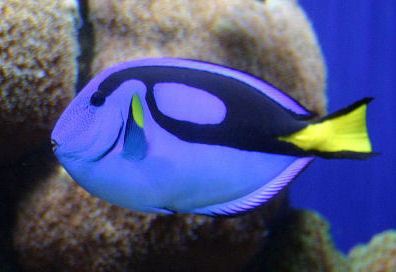
The blue tang made famous from the movie "Finding Nemo" (Pixar) is a great fish to have in a saltwater reef or fish only tank. They have a great personality and in a large tank are awesome to watch as they glide through the water. I currently have one in my 3 foot reef tank however, I do believe they go through growth spurts and, one day will need to be relocated to another home due to his/her size.

The blue tang (Paracanthurus hepatus - part of the surgeon fish family) is know by many different names such as Hippo tang, Pacific Blue tang, Regal tang, Blue surgeon etc etc. They are easily distinguished from other tangs by the bright blue/purply colour on their bodies with a distinctive black pattern which runs from their eye to their tail. The tail of the Blue tang is a magnificent yellow bordered with a black outline and, it also has a sometimes hard to see spike on its caudal fin which it uses to defend itself.


When placed in a tank with other Surgeon fishes (i.e. sailfin tang etc) they can become Territorial until it has settled in. My blue tang for instance was under a bit of stress when first introduced into my reef tank battling with my Sailfin Tang; after a while this rivalry subsided.


I do believe they can grow quite large and, have a massive appetite so best to place in a tank of at least 300 Litres so that it has sufficient room to grow and swim.


They are very easy to keep once your tank is cycled and, mine will pretty much eat anything although a sensible option would be to put mix their diet by providing them with Nori seaweed, brine shrimps, plankton mix and maybe some flake food... better for them as they will benefit from the varied diet.


I would recommend a Blue Tang to anyone as they are awesome fish to watch swim around and, come with a lot of personality which make your aquarium that much more exciting to watch.
And, of course optiomal water condiotns are the key.....


Peace

Monday, March 22, 2010

fishy tales - a break from the serious stuff


Sunday, March 21, 2010

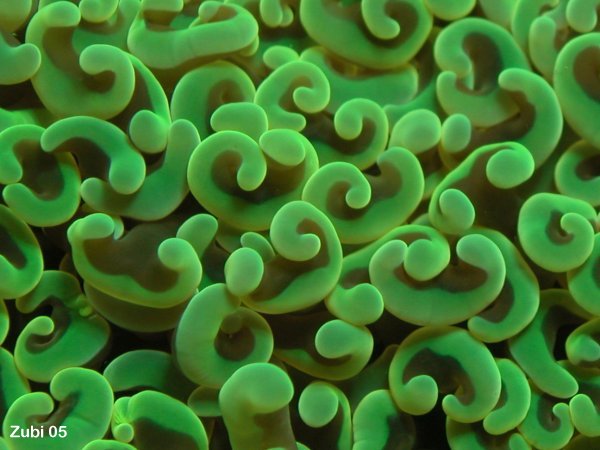
Hammer Corals - Euphyllia ancora


Common name : Hammer coral, Anchor coral
Scientific name : Euphyllia ancora


The Hammer coral is a type of Large Polyp Stony coral and is a great beginners coral.

It has polyps with tentacles which extend from the body of the coral with hammer/anchor/t-shaped ends which are often a lighter colour than the rest of the polyp.

This coral is relatively hardy and can tolerate varied water conditions. It has varied lighting requirements i.e it is my opinion that if the coral itself is brighter in colour (bright green/orange etc) probably has a more aggressive lighting requirement compared to a more plain coloured or regular (browny/pink) Euphyllia.

It can be aggressive so give it a fair bit of room - at night the coral can send out sweeper tentacles which can sting other corals. Once it is full extended during the day it does tend to take up a large amount of space.

These corals don't like direct water flow but, more a gentle current to keep the polyps waving around.

Euphyllia can get all their food through their symbiotic zooxanthalae but, can be target fed.

Best placed midway to lower down in the tank and will do best in a reef system that has a good calcium level and, temperature between 22 - 27 degrees Celsius.


Sunday, March 7, 2010

4 foot salt water crystal clear

BEFORE


AFTER


Woohoo as you can see the 4 foot has cleared itself right up - the photo quality isn't that great becuase, I was using my 3.2 megapixel mobile phone however, I think you can clearly see the difference in water quality. I haven't been around for over two weeks and, the algae on the glass was minimal the water chemistry was perfect and, all the fish were super hungry :>

What really amazed me was the size of all the corals after adding the chemical filteration (Biochem Zorb) - the cataphyllia was huge and, the same with the hammer/anchor coral. Now I believe what created the most problems in this tank was the particulate matter floating around in the water and, this was inhibiting the corals opening to the max. Now that the extra chemical filteration has been added the differences you can see are massive. You can also see the Kenya tree is recovering from where I hacked off a branch and, the Moorish Idol is healthy and, appears to be picking and, eating algae of the rocks ... pfffew ;...>


The unfortunate news is as this tank is being relocated shortly I don't believe there will be the addition on many more corals or fish.


Tuesday, February 16, 2010

3 foot saltwater update


Full tank pic above - I have copped the xenia corals so they might not look as full in the whole tank picture ..

Pulse coral below
so here are a few pictues of my 3 foot after the addition of a few corals etc. I have added a fungi, pulse coral, Kenya tree coral, a blue tang plus some extra live rock in the sump. I am really happy with the way this tank is turning out :> the corals are all opening up very nicely, the fish are all getting along very well and algae is down to a minimum and, this is mostly due to the fact that this tank is now cycled + purigen did help. The Acropora unfortunately isn't doing to well - I have cut off all the dead bits and, just kept the good parts and glued it to a piece of rock however, I don't have much hope for that coral. this tank is predominantly soft corals + LPS's so not sure if the acro is suited for this environment. I do hope to change the freshwater to a SPS tank in time .... but one thing at a time.


I haven't used my protein skimmer in ages however, I have added some additional live rock to the sump + some caulerpa to absorb the nitrate (not that there was much at all- last time i measured it was below 10 ppm). The live rock will also help with the regeneration of the macro algae which the tangs will definitely devour from the tank. Next thing would be add a chiller to keep the tank temperature stable as I do think that the temp. fluctuations have contributed to the acro's demise however, the other corals + fish seems to fine with this fluctuation.

Monday, February 15, 2010

Purigen

So went to my local fish store trying to find some Biochem Zorb or Polyfilter i.e. to absorb waste products and, make the water quality better for the reef tank. However, they were out of both and I had used Biochem zorb in another aquarium and, it cleared the water right up beautifully :> It also works great in a freshwater planted tank.

Anyways, the fish store was out of this product and, instead they suggested "Purigen" which is a exchange resin removing waste by-products keeping phosphate, nitrate, nitrite and ammonium down. It also aide's in clearing up the water of floating debris or tiny particles which can cloud aquarium water. The good thing about this resin is that it doesn't effect trace elements in your water (well minimally as it is a type of carbon filter media).

After buying the product I did some online research and looked up Purigen which is made by a company called SEACHEM. There website is very informative and, full of great articles about aquarium keeping.

*** the great thing about this product is that you only require 100mL of purigen to treat 400L of water - others products usually aren't as effective i.e. 100mL treats 150L per water etc. Also, this product claims to last up to 6 months (of course this would depend on how much waste your tank produces..) + is regenerable i.e. once it turns black you treat it and, you can use it again :> Information on the website link I have provided. I must also mentioned that I love the fact that there are heaps of juicy details about how the product works and, product support available on the SEACHEM website.

On another note :

I will post some photo's of my tank as recently I have added a Kenya tree, also a nice white fungi and, rearranged the corals etc + the mushroom polyp I propagated has turned is now three separate polyps and, growing great!

I aim to pack this tank as full of corals as possible and, will be focusing on a soft corals and Large polyp stony corals - this is because, the tank is predominantly these type's of corals and, hopefully this will keep the coral warfare to a minimum. Also, I have introduced a blue tang who at first was last on the pecking order in the tank being attacked by the yellow chromis and sailfin tang(very annoying) however, this settled after a few days and, they all seem to be getting along very well. I do believe that the unusual habit of the blue tang wedging himself in between rocks was what set off the chromis i.e. he kept wedging himself into the rock that I think the yellow chromis called home so it became very territorial.

Also, I hope to change the mini-reef into a refugium style filter i.e. simplistically by adding some more live rock with some Caulerpra or other type of algae + add a light to the inside of the cabinet.

Once this tank is complete I hope to put it up for sale! A complete tank with all the corals/fish etc.

Go check out the links for Biochem zorb, Purigen, polyfilter etc all great products which really do make aquarium keeping that much easier and, that much more rewarding.

Friday, January 29, 2010

4x2x2 update


I thought I would post some updated pics of the 4x2x2 that I have been working on slowly. Now you will notice that these pictures aren't fantastic and, this is because, I have uploaded them using my mobile phone which only has a 3 mega pixel lens....

Also, its worth noting that this tank is running on about 220 watts of lighting mixed between Blue and true daylight bulbs. In total there is roughly 550 litres of water with the sump included so this lighting is slightly insufficient for ideal growth of corals. Some of the low light requiring corals don't mind i.e. the fungi, cataphyllia, bubble coral, soft corals i.e. the Kenya tree, devils hand and, also corallimorph don't care (but, I think they would definitely do better on about 1 watt per litre).... but, the LPS in the top left hand corner is suffering and, this is evident by the fact that it doesn't fully open. You will be happy to know that we are on the hunt for some Metal halides with LED's and blue T5's to make this tank look spectacular.

After a few weeks I have removed all the bio balls from the sump left the coral sand and hope top add some live rock to the mix. There is also some filter wool and some filter foam. The protein skimmer is working like a charm and, skimming away but, I think the lighting will be the key. We have been adding coral trace elements and, the corals actually seem like they are coming back - the bubble coral is starting to grow again ! and, the corallimorph are getting massive - so all in all tank is slowly getting better.

Also, have added a Moorish Idol to the tank which I know aren't the easiest fish to look after however, this guy is seems to be feeding well looked really healthy when i bought him and, hasn't been picking at the corals - they are known to go without any reason however, we will see how this fishy goes. By the way the first picture is a panoramic shot so there is a GHOST Moorish idol ... there is actually only 1).


a bit of overkill with the filter media right????

Wednesday, January 20, 2010

Wow - great info

So if your after a bit of information about those hitchhikers you get in your tank or even how to diagnose some conditions that commonly occur when starting up or even in a well established aquarium check this out - some very interesting links to types of macro-algae.

http://www.reefs.org/hhfaq


Thursday, December 31, 2009

Aquarium Lighting - FLOURO's "lighting for thought"

I have been running the planted tank for a while now and, I have been unhappy with the plant growth - I double checked my flouro's and, they were tri-phosphor t8's. On previous planted tanks I have used say a 3 foot flouro with predominantly a blue spectrum + a 3 foot bulb with a predominantly red spectrum. So Basically never used tri-phosphor t8's by Phillips or NEC before however, was told they were good for aquariums.
Now after doing a fair bit of research I have discovered that these particular tri-phosphors are very high in the green spectrum of light therefore, appearing brighter to the human eye. For fish only aquariums this wouldn't pose a problem however, for planted tanks such as mine this is not beneficial as the plants absorb predominantly the red spectrum for growth.

Basically the best type of bulb for planted aquariums which I might add aren't hugely popular from what I can tell in Australia (or sydney at least) are the flouro's which are high in the red spectum of light + blue also .... but, red being more important.

Both bulbs are 30 watt - therefore giving my tank a total of 60 watts of lighting to 120 litres of water = 2 watts per liter which should be very sufficient for a planted tank.

Go check out the following links for some more information on lighting:

http://watershed3.tripod.com/lighting.html
http://aquaticconcepts.thekrib.com/Articles/AFM_Lighting.htm

Wednesday, December 30, 2009

20000k 150 watt + some corals etc

As you may have read it is important to replace your Metal Halide(MH) bulbs every 12 - 18 months as the wavelengths of light (colour) tend to shift therefore, not giving your corals etc etc the best spectrum possible. When I first started this blog I added a 150 watt MH with I believe a 13000K bulb. I purchased the tank + accessories of eBay so wasn't 100% sure how long it had been since the bulb had been changed so decided to purchase a new bulb.

There are a number of different types of MH bulbs available i.e. in terms of Kelvins. The standards ones you are able to find in OZ include:

- 6000K (High-end planted tanks - gives your aquarium a very yellow looking light)
- 13000K (Marine aquarium - with some corals however, lacks blue wavelengths therefore, corals won't look as nice - probably not the best for Small Polyp Stony {SPS} corals - white looking light )
- 16000K (a mix between the white and blue spectrum provided between 13000K and 20000K - would work well for reef or coral free aquariums - crisp white light)
- 20000K (This brings out the best colouring in your corals + gives your water a colour similar to deep ocean .... blueish lighting)

Everyone is different and prefers different lighting for their aquariums but, I would suggest you go for the crisp white light as a minimum for your tank if using MH's.
Another reason that I did change my lighting to 20000K bulb was because, I noticed that my SPS corals weren't doing as well with the old 13000K bulb. I recently bought a Acropora and after putting it in my tank it appeared to go a tinge of brown (Itc ould just be due to a conditioning period....). I have read and, I don't know how plausible this but, when the wavelength of light drops off the Zooxanthellae in the corals move forward i.e. into the top layer of the coral and therefore the coral loses its colour and, goes a brown colour due to zooxanthalae being brown (Not sure this has been proven either way). I can say however, that after changing the bulb the Acropora and Montipora's colouring improved.

So have attached a couple of pictures so you can compare:

Nice Flouro Orange Fungi

Bi-Colour Hammer Coral (LPS)

2 x Monti Plates
Acropora (was a dark brown when I fist put it in the tank but, now is starting to colour back up)